
Criminal Defense: Courts & Process
How to Choose a Criminal Defense Lawyer for a Massachusetts Criminal Matter

Build a focused first-contact plan
Treat the first contact as a focused way to establish what can be discussed and what still needs case-specific legal review. You can identify the Massachusetts criminal matter, describe the procedural stage you understand, and ask how to provide documents or sensitive details. The exchange is not a decision about the merits or outcome of the case. Its immediate purpose is to create a clear starting point for a later consultation and to identify the questions that should be answered by a lawyer who considers your circumstances.
A useful first-contact plan has three parts:
- Describe the procedural stage you understand, such as an arrest, a charge, a court date, or a conviction.
- Bring the questions and documents that will help the lawyer understand what has happened.
- Assess whether the lawyer’s experience, communication, and proposed role fit the matter you need to address.
This approach keeps the conversation focused on your actual decision rather than on a promised result. Choose whether to continue only after you understand what the lawyer can discuss and what remains uncertain.
Charged? Talk to Attorney Reinhardt.
Leave a name and a number — he reviews every request personally.
Stage information for a Massachusetts criminal defense consultation
First contact with a Massachusetts criminal defense lawyer does not have to contain every detail of a matter. Begin by identifying whether you want general legal information or are asking about the possibility of representation. Under Massachusetts Rule 1.18, a person becomes a prospective client by consulting with a lawyer about possibly forming a lawyer-client relationship for a matter. Whether a communication is a consultation depends on the circumstances, including what information the lawyer requested and what warnings were provided. Describe the general subject and procedural setting first; use a consultation for case-specific questions rather than treating an initial message as a complete case presentation.
Depending on the matter, a defense lawyer may evaluate the case, advise you, negotiate with prosecutors, appear in court, and develop defenses to the prosecution’s case. Those functions can require different kinds of communication from you. A lawyer may need the charging information to identify the allegation, the court information to understand the next procedural event, and your account of what occurred to frame questions for further review. The exact work depends on the matter.
Before you judge whether a lawyer fits, ask what role the lawyer expects to perform in your situation:
- What does the lawyer understand the current issue to be?
- What information or records are needed before the lawyer can assess it?
- What decisions would remain yours, and what legal work would the lawyer handle?
- How would communication, fees, and the scope of representation be addressed?
Massachusetts professional-conduct rules address competence, representation scope, diligence, communication, fees, confidentiality, and conflicts of interest in the client-lawyer relationship. Use those subjects as a practical checklist for the conversation, not as a substitute for discussing the terms that apply to your matter.
After the first contact, write down what was actually established. A consultation can provide an opportunity to discuss the specifics of a Massachusetts criminal case, understand potential legal options, and prepare for next steps. Record the general issue discussed, any information or records the lawyer asked you to provide, and the subjects left for later review. If the conversation moves toward representation, make sure the scope, communication, fees, confidentiality, and conflicts are addressed rather than assuming that a first exchange answered them. This record shows what remains unresolved before you decide whether to pursue further discussion.
Keep an allegation, charge, and conviction distinct
An allegation, a charge, and a conviction describe different points in a criminal matter. An allegation is an asserted account of conduct. A charge is the criminal accusation being pursued. A conviction is a legal outcome after the relevant process. Do not describe an accusation as an established fact when you speak with counsel, and do not assume that a charge answers what the final result will be.
Your consultation notes should preserve the distinction by recording the exact wording you have, the source of that wording, and the stage you understand the matter to have reached. If a document uses a term you do not understand, mark it as a question instead of translating it into a conclusion. Give the lawyer the document or precise information, then ask what the language means for the next decision.
The practical action is simple: organize the matter by status before you evaluate possible representation. Identify what is alleged, what has formally been charged, and whether any conviction has occurred. That organization gives the lawyer a clearer starting point and helps you avoid relying on a conclusion that the available information does not establish.
Know where general information stops
General legal information can explain the kind of work a defense lawyer may perform and the subjects you should raise. It cannot determine how those subjects apply to your particular facts. Massachusetts rules recognize that whether a lawyer-client relationship exists for a specific purpose can depend on the circumstances. Treat a general explanation as a way to prepare questions, not as a decision about your case.
Avoid turning a general description into a case conclusion. The fact that a lawyer may negotiate with a prosecutor does not establish that negotiation will occur in your matter. The fact that a lawyer may develop defenses does not identify which defenses, if any, apply to your facts. The fact that a lawyer may appear in court does not tell you what the next hearing will address. Ask the lawyer to separate what is known from what requires further review.
Use these boundaries during the first discussion:
- Treat the charge or allegation as the subject for review, not as proof of guilt.
- Avoid sending extensive confidential details before you understand how the lawyer handles prospective-client communications.
- Ask which answer depends on records, procedural history, or facts that still need to be examined.
- Write down the questions that cannot be answered responsibly without that review.
Then use the answers to decide whether a fuller consultation is appropriate.
Use the consultation to organize the next discussion
A Massachusetts criminal defense consultation can give you an opportunity to discuss your case, learn about potential legal options, and prepare for the next steps. The meeting is a place to connect your account and available records to the questions that matter, not a reason to convert uncertainty into a legal conclusion before the relevant information is reviewed. Prepare a concise account, preserve the wording of your documents, and identify the points you need explained. That preparation lets the discussion distinguish known information from questions requiring further legal attention.
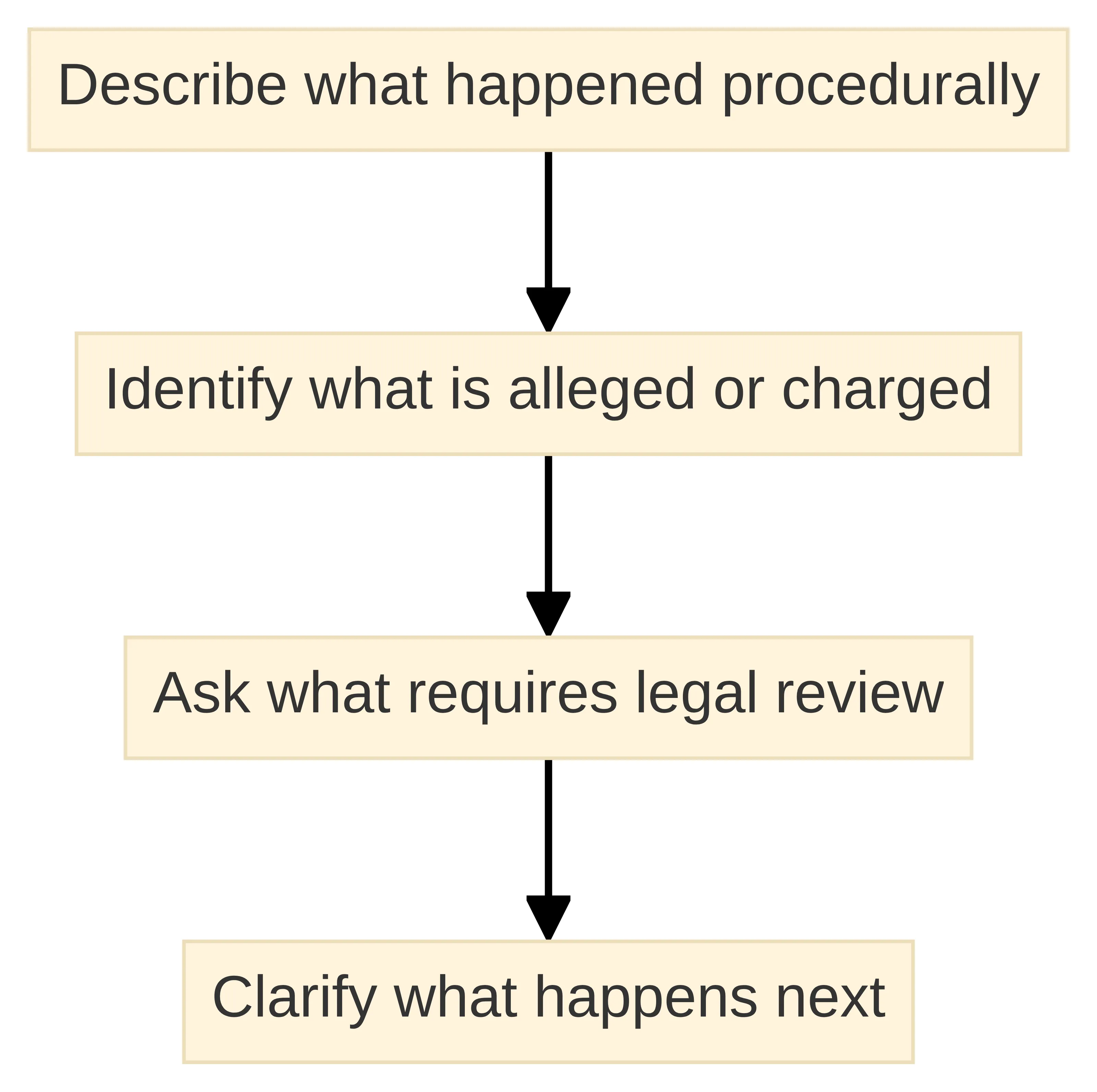
The conversation may move through several subjects:
- What happened procedurally. Explain the event that led you to seek counsel and identify any court or agency information you have.
- What is being alleged or charged. Use the language in your documents where possible, and separate your understanding from what the document actually says.
- What questions require legal review. Ask about the scope of the lawyer’s possible work, the information needed, and the decisions that remain open.
- What happens next. Clarify the next discussion or action you should take if you decide to continue.
The lawyer may evaluate the matter, advise you, negotiate with prosecutors, appear in court, or develop defenses depending on the circumstances. Do not assume every consultation includes every function.
A consultation is also a fit decision. Consider whether the lawyer explains the matter in terms you can follow, answers your questions directly, and gives you a clear understanding of the proposed role. Experience and qualifications matter, but so does your ability to work comfortably with the lawyer. If the discussion leaves the role or next step unclear, ask for clarification before making a representation decision.
Share initial information with confidentiality in mind
Confidentiality depends on the relationship and the circumstances of the communication. Massachusetts rules distinguish confidentiality duties for current clients from duties concerning confidential information shared by prospective clients. Rule 1.18 treats a person as a prospective client when that person consults with a lawyer about possibly forming a lawyer-client relationship for a matter, but whether a communication is a consultation depends on the circumstances, including what information the lawyer requested and what warnings were provided.
Use a measured first message. Identify your name, the general type of Massachusetts criminal matter, the relevant location or court if known, and any immediate timing issue you understand. Ask how the lawyer wants you to provide confidential details and whether the lawyer has instructions for submitting documents. Avoid placing unnecessary sensitive information in an unsolicited message before you understand the requested channel and any warnings.
We offer free and confidential consultations. That business policy does not turn every communication into a completed representation agreement or answer whether a specific communication receives the same treatment as information provided by a current client. Give enough information to allow an initial response, follow the requested consultation process, and reserve detailed case discussion for the appropriate conversation.
Before sending sensitive material, take these steps:
- Read any warning or instruction attached to the contact method.
- State whether you are asking about possible representation rather than assuming representation exists.
- Share only the initial facts needed to identify the matter unless the lawyer requests more.
- Keep copies of what you send and note when you sent it.
If you are unsure what to disclose, ask how to proceed instead of guessing. Use a staged disclosure decision rather than treating first contact and consultation as the same exchange. The first message can establish the matter, timing, and requested contact without becoming a full account of disputed events. After the office identifies the appropriate process, you can provide the information the lawyer requests through the channel and with the warnings or instructions supplied. This sequence helps separate three questions: what is needed to identify your request, what should be reserved for a consultation, and what should not be sent until you understand the communication process. Keep the first message focused, and ask for clarification before expanding it when the requested channel or scope is unclear. An accurate first contact can be brief without being vague: state what you know, identify what you do not know, and ask for the next communication instruction. That is different from minimizing the matter or deciding which facts are legally important.
Assemble a consultation record
A short, organized consultation file can help keep the discussion anchored to what is known. Prepare the information you have without editing it into a legal conclusion. A useful file includes:
- The date and general location of the event, if known.
- The agency, court, or other authority identified in your paperwork.
- The exact charge or allegation as written in the document.
- Any summons, complaint, citation, release paperwork, notice, or court date you have.
- A concise timeline of what happened before, during, and after the event.
- Names or contact details that appear in the records, while keeping sensitive information within the requested communication process.
- A separate list of missing documents, uncertain dates, and terms you want explained.
Keep the original wording where possible and arrange the material by document, date, and question. If you do not have a document, say that plainly rather than reconstructing its contents from memory.
A timeline should distinguish what you personally observed from what someone else told you and what a document states. Mark uncertain times or missing records as uncertain. This format gives you a way to answer basic questions without overstating what you know, and it gives the lawyer a starting point for identifying which facts or records need closer review.
Write your questions before the meeting. Useful questions include:
- What does the lawyer understand the current procedural stage to be?
- What information is needed to evaluate the matter?
- What work might the lawyer perform, and what would remain outside the proposed scope?
- How would communication occur, and who would handle questions?
- How would fees and the scope of representation be addressed?
- What should you do next, and what should you avoid assuming before that next step?
These questions track subjects recognized in Massachusetts professional-conduct rules, including competence, scope, diligence, communication, fees, confidentiality, and conflicts of interest. They do not require you to know the legal answer in advance. Add a disclosure-and-document check to your question list. For each item you might send, note whether it is (1) needed to identify the matter, (2) a document the office has asked to review, (3) your own account, or (4) a question that requires legal discussion. This sorting is not a legal classification; it is a way to keep the first contact proportionate and preserve the difference between a record, a recollection, and an unresolved issue. Ask:
- Which information is needed before a consultation can be arranged?
- Should documents be provided before the consultation, and which communication method should be used?
- What warnings or instructions apply to information shared while I am considering possible representation?
- Which timing or court information should be placed in the first message?
- If the office needs more information, what should I provide next?
If an answer depends on circumstances the office has not yet reviewed, record it as an open question rather than filling the gap with an assumption. Keep the resulting list with your consultation file so you can compare what you sent with what you were asked to provide.
The purpose of preparation is clarity, not a complete legal theory. You do not need to prove your position before speaking with counsel. Give a careful account, identify the documents you have, and let the consultation identify which questions require case-specific legal analysis.
Review what the consultation established
After the consultation, review what the discussion actually established rather than relying on a general impression. Relevant experience and qualifications are part of the decision, but the consultation should also leave you able to identify the proposed role, the information still needed, and the way communication would occur. Working comfort matters because you need to communicate about difficult facts and understand the lawyer’s explanations. Record those concrete points separately from any prediction about the case.
Use this checklist during or after the consultation:
- Matter fit: Can the lawyer explain how the lawyer’s experience relates to the type of criminal issue you described?
- Communication: Can you understand the explanation, ask follow-up questions, and learn how future communication would work?
- Scope: Can you identify what the lawyer may handle and what remains outside the proposed representation?
- Preparation: Does the discussion identify the records and facts that need review?
- Professional terms: Have you discussed fees, confidentiality, conflicts, and other terms relevant to the relationship?
- Working comfort: Can you speak candidly and respectfully with this lawyer about difficult facts?
The checklist helps you compare what you heard without reducing the choice to advertising language or a predicted result.
If you speak with more than one lawyer, use the same questions for each conversation. Record the answer, the question it addressed, and any issue that still requires clarification. Do not treat a confident prediction as a substitute for a clear explanation of the lawyer’s role. Choose only after you understand the differences that matter to your situation.
A lawyer’s possible functions can vary by matter. Evaluation, advice, negotiation, court appearances, and development of defenses are different forms of work, and a consultation may not establish that every form will be needed. Ask which functions are relevant to the stage you have reached, then use that answer as the basis for your fit decision.
Review the office’s stated consultation process
I am Michael R. Reinhardt, a criminal defense attorney and the owner of the Law Office of Michael R. Reinhardt. I handle Massachusetts criminal defense matters. When you assess our practice, compare that stated focus with the type of charge or criminal-court issue you need to discuss.
I have over 30 years of experience in criminal defense and over 30 years of experience in Massachusetts criminal courts. That background is one fact you can consider when deciding whether to request a consultation. It is not a conclusion about the legal issues, defenses, procedure, or outcome in your particular matter.
We judge every case we handle on its own facts and circumstances. I personally handle cases and answer the phone for my clients. Those statements describe how our practice approaches case review and communication; they do not replace the discussion needed to understand your specific situation.
Use the consultation to test the fit between your needs and our stated approach. Explain the general matter, ask what information is needed, and ask how the proposed work and communication would be handled. We offer free and confidential consultations, and I review every request personally and respond promptly. Ask any question needed to understand the next step before deciding whether to proceed.
No firm-specific description can establish which legal work your matter requires. The facts and circumstances of your case control the discussion. Use our experience and stated communication approach as factors in your decision, then seek the case-specific explanation you need before choosing representation.
Send a focused request for a consultation
You are prepared for a consultation request when you can identify the Massachusetts criminal matter, separate the allegation or charge from any conviction, gather the records you have, and list the questions you need answered. Keep a concise first-contact message separate from the fuller consultation file. Preserve the wording of documents, mark uncertainty, ask how sensitive information should be provided, and record the proposed scope and communication process. This gives the next discussion a clear starting point without relying on a predicted result.
A qualified Massachusetts lawyer must determine how legal rules apply to your individual facts and whether representation is appropriate. General information cannot make that determination for you. If your matter requires that review, provide the organized information and questions you have prepared and take the next step toward a consultation.
Questions to resolve before contacting a Massachusetts criminal defense lawyer
What should I prepare before a consultation with a criminal defense lawyer in Massachusetts?
Before your consultation, gather relevant documents such as any charges or allegations, court dates, and a timeline of events. Prepare specific questions about the lawyer’s experience, the legal process, and what to expect moving forward.
What factors should I consider when evaluating a criminal defense lawyer?
Consider the lawyer’s relevant experience, communication style, and whether you feel comfortable discussing your case with them. It’s important to ensure they understand your specific legal needs.
What can I expect during a consultation with a criminal defense attorney?
During the consultation, you can discuss the specifics of your case, understand your legal options, and outline the next steps.
How can I determine if the Law Office of Michael R. Reinhardt is the right fit for my case?
Evaluate the firm’s experience in handling cases similar to yours, assess their communication style during your consultation, and ensure you feel comfortable working with Attorney Reinhardt.
Charged with a crime?
Talk to a criminal-defense attorney who knows the Massachusetts courts.
Attorney Michael R. Reinhardt offers free, confidential consultations across Middlesex, Suffolk, and Worcester counties.
More on Criminal Defense: Courts & Process
See every practice area Criminal Defense: Courts & Process
How to Choose a Criminal Defense Lawyer in Massachusetts
Learn how to choose a Massachusetts criminal defense lawyer, compare fit, prepare for a consultation, and decide your next step.
Read article Criminal Defense: Courts & Process
7 Essential Steps to Prepare for Your Hearing Successfully
Prepare effectively for your hearing - np/stet/dismissal/abd with these 7 essential steps for success.
Read article Criminal Defense: Courts & Process
4 Steps to Get Off Probation Early for Good Behavior
Learn how to get off probation early for good behavior with these essential steps and insights.
Read article