
OUI / DUI Defense
Should You Contact a Massachusetts DUI Attorney? A Case and License Decision Guide

Decide what a Massachusetts DUI/OUI consultation can clarify
A Massachusetts DUI/OUI consultation can help you organize two related but different questions: what may happen in the criminal case and what may happen to your driving privilege through the Massachusetts Registry of Motor Vehicles. The value of that conversation is not a promised result. It is a structured review of the facts that control both tracks, followed by practical next steps.
An OUI charge can create pressure from several directions at once. You may be trying to understand an upcoming court date, a suspension notice, a breath-test or refusal issue, possible effects on work, or the significance of an earlier offense. Those concerns should not be collapsed into one assumption about your case. Your offense history, the way testing or refusal was documented, the evidence available, and the eventual disposition can change the analysis.
A Massachusetts DUI attorney can help you separate criminal-case questions from Registry questions and connect each question to the records that bear on it.
This guide gives you a way to prepare for that review without predicting your result. If you are deciding whether to make contact, begin by gathering the facts you can document and by keeping criminal-case questions separate from license questions.
You may want case-specific assistance if you have been arrested or charged, received a Registry notice, refused or incompletely completed a test, have a prior OUI-related history, or do not understand what your paperwork requires. The presence of one of those circumstances does not determine the outcome. It does give you a concrete reason to ask for a focused review rather than rely on a general penalty description.
Charged? Talk to Attorney Reinhardt.
Leave a name and a number — he reviews every request personally.
What a Massachusetts DUI/OUI attorney can evaluate
A Massachusetts DUI/OUI attorney can evaluate the legal and factual parts of the allegation instead of treating the charge label as the entire case. Potential review areas include the stop, the way evidence was obtained, the reliability of blood or breath evidence, license consequences, and effects on a professional license.
Our OUI defense process includes scrutinizing field sobriety tests and breath-machine calibration and certification. That review is directed at the details surrounding the evidence.
A consultation can help you sort the material into questions such as these:
- What exactly does the charging document allege, and what stage has the criminal case reached?
- What did the officer observe, request, record, and report?
- What testing occurred, what testing did not occur, and how was any refusal or incomplete test described?
- What notice or action came from the Registry, and what deadline or requirement appears on it?
- What does your prior record show, and how might the disposition of an earlier matter affect the present analysis?
- Does your work depend on driving or on a professional license that may require separate attention?
These questions do not assume that the Commonwealth can prove the charge, that the Registry will impose a particular suspension, or that a defense issue will prevail. They identify the subjects that deserve examination.
I am a criminal defense attorney and the owner of the Law Office of Michael R. Reinhardt. I have over 30 years of experience in Massachusetts criminal courts. We judge every case on its own facts and circumstances. That means your consultation should begin with your records and account of events, not with a conclusion borrowed from someone else’s case.
Overview
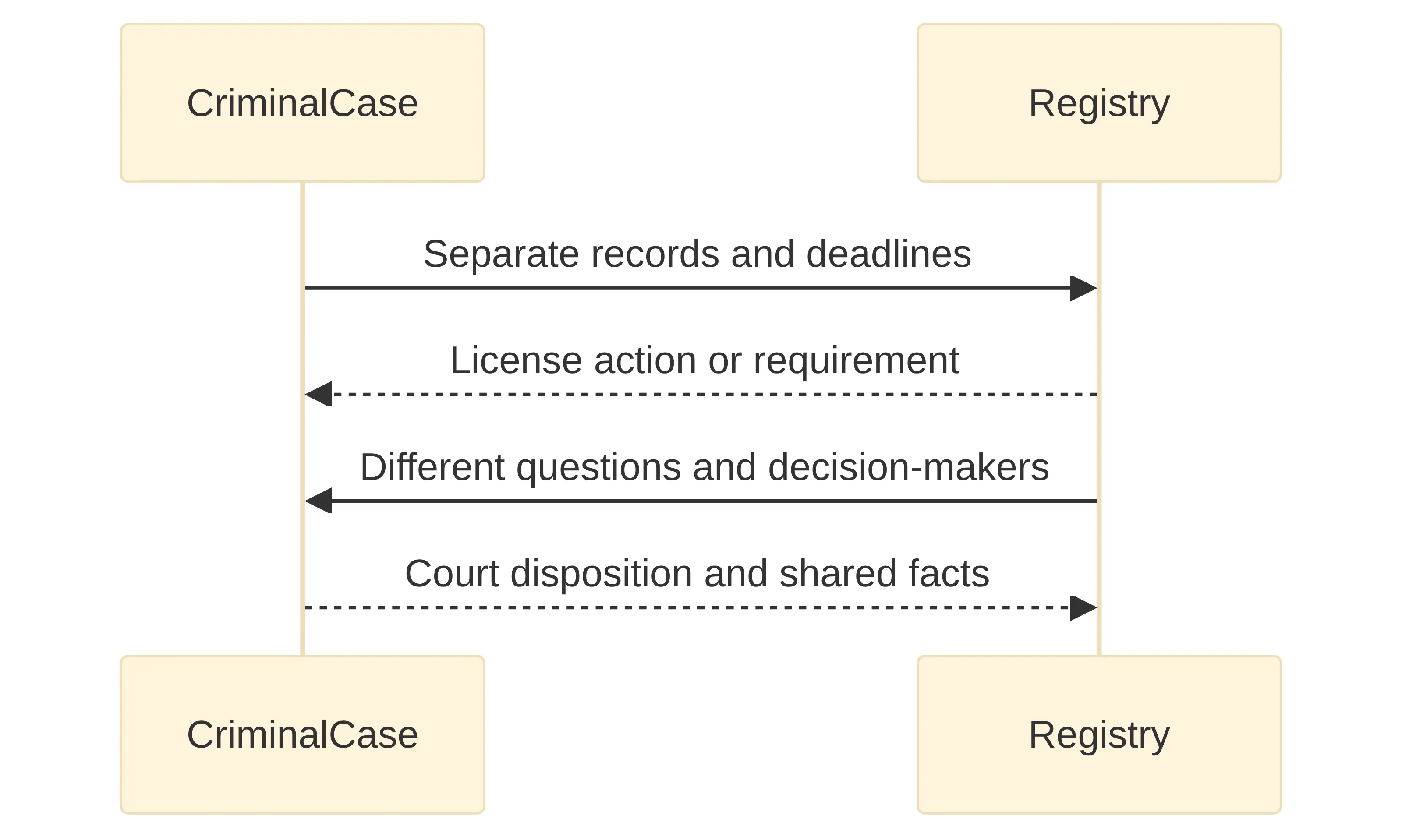
A Massachusetts OUI matter has a criminal-case track and a Registry track. The tracks can affect each other, but they ask different questions and may involve different records, deadlines, and decision-makers.
| Track | Main question | Information to organize |
|---|---|---|
| Criminal case | What does the Commonwealth allege, what evidence supports the allegation, and how should the case proceed? | Charging papers, court dates, police or testing records if available, and your factual timeline |
| Registry consequences | What happened to your license or right to operate, what action did the Registry take, and what current requirements apply? | Registry notices, prior driving-history information, proof of any assignment or completion, and deadline information |
In a Massachusetts criminal case, the defense attorney represents the defendant while the prosecutor represents the Commonwealth. At trial, a criminal defendant may have a jury decide guilt or innocence or choose a bench trial decided by a judge.
A separate license question can arise even while the criminal allegation remains unresolved. For example, Massachusetts information describes a first-OUI Driver Alcohol Education Program assignment as capable of resulting in an RMV-ordered 45-to-90-day suspension or revocation, subject to the circumstances described by the Registry. The existence of that possibility does not tell you which action applies in your situation.
Massachusetts impaired-driving programs are state-approved programs licensed by the Department of Public Health’s Bureau of Substance Addiction Services. A program reference, a court disposition, and a Registry action should therefore be recorded as separate facts rather than treated as interchangeable terms.
Use the two-track structure as a working map. Put every fact you know into the track it affects, then mark facts that may affect both. That simple separation can make your questions more precise and can prevent a general discussion of the criminal charge from being mistaken for an answer about your license.
Create a case snapshot from documents and facts
A case snapshot is a short, dated account of what happened, what paperwork you received, and what you still need to understand. It gives you something concrete to use during a consultation. It is not a substitute for the records themselves or for legal review.
Start with the documents you can locate:
- The complaint, citation, summons, or other charging paper.
- Any arraignment notice, court notice, release paperwork, or conditions you received.
- Every Registry notice concerning a suspension, revocation, refusal, test, hearing, or right to operate.
- Any paperwork describing a breath test, blood test, field sobriety exercise, or incomplete test.
- Prior OUI-related court or Registry documents, if they are available.
- Documents showing a program assignment, completion, or other disposition, if one exists.
- Information about a professional license or employment requirement that depends on driving or a clean record.
If a document is unavailable, write down its name, the date you saw it, who gave it to you, and what you remember it saying. Do not fill gaps with guesses. A missing document is a question to raise, not a reason to invent a detail.
Record the facts in chronological order. Include the location and approximate time of the stop, the reason given for the stop if you know it, what happened before the arrest, what you were asked to do, what you agreed to or declined, and what happened after the arrest. Separate what you personally remember from what a document says and from what someone else told you.
Also record the facts that can change the scope of the review:
- Whether the matter is a charge, a pending case, a dismissal, a plea, a conviction, or another disposition.
- Whether you have an earlier OUI-related matter and what its actual disposition was.
- Whether the Registry has sent a notice and what deadline appears on it.
- Whether you completed or were assigned to an impaired-driving program.
- Whether physical, medical, language, weather, road-surface, footwear, or other conditions affected a roadside exercise, if those details apply.
- Whether your job, school, family responsibilities, or professional license depend on driving.
Keep the snapshot factual. Statements such as “the case is over,” “the suspension is automatic,” or “the missing breathalyzer ends the charge” may express understandable fears or hopes, but they are conclusions that require case-specific review.
Bring the snapshot and the documents you have to the conversation. Do not delay asking for help simply because your file is incomplete; tell the attorney exactly what is missing. A clear list of known facts, disputed facts, deadlines, and unknowns is more useful than a confident but inaccurate reconstruction.
Use the snapshot as an index to the file, not as an argument for a preferred result. A simple entry can identify the document or memory, its date, the track it concerns, and the question it creates. For example, label a Registry notice by the date and action stated on the notice; label a recollection as your recollection rather than as a fact established by a record. If the same event appears in a court paper, a Registry notice, and your own memory, keep each version visible and note the difference instead of silently choosing one. Put urgent dates at the top, but preserve the full notice so the surrounding language is available for review. This format lets a consultation begin with the points that need decisions rather than with a long, unstructured story. It also makes it easier to identify which missing record would answer a particular question.
Separate the criminal case from Registry consequences
The criminal case and the Registry consequences should be reviewed as separate tracks because a court allegation does not answer every license question. The criminal track concerns the charge and the evidence used to pursue it. The Registry track concerns your license or right to operate, the event reported to the Registry, and the action or requirement attached to that report.
The two tracks can also use different descriptions of the same event. For an incomplete breath test, the consequence can depend on how the officer reports the event. It also identifies additional suspension risk for some drivers who pursue a different characterization of that event. That is a reason to examine the report and your history before assuming that a test, refusal, or incomplete test has one universal consequence.
A first-OUI Driver Alcohol Education Program assignment can also involve a Registry suspension or revocation of the learner’s permit, license, or right to operate for 45 to 90 days as described by Massachusetts Registry information. That description does not establish that the same period applies to every person or every disposition.
Use separate headings in your notes:
- Criminal case: charge, court, allegations, evidence, defense questions, and disposition.
- Registry matter: notice, suspension or revocation language, reported event, deadlines, and requirements.
- Shared facts: prior history, testing or refusal, program information, and facts affecting both tracks.
If a notice has a deadline, put the date at the top of your snapshot and ask about it directly. Do not assume that pursuing the criminal case automatically resolves the Registry matter, or that a Registry action proves the criminal allegation.
For each unresolved issue, use the same sequence: identify the event, identify the document describing it, identify the track to which the document belongs, and then write the question that remains. A court paper may help establish the procedural stage of the criminal case, while a Registry notice may describe an administrative action; neither document should automatically be used as a substitute for the other. If the descriptions differ, preserve both and ask how they relate. This approach is especially useful when one event appears in several records with different labels. It keeps the review focused on the source of each conclusion and helps prevent a decision about one track from being mistaken for a decision about both.
Review the criminal case from arraignment through resolution
The criminal case begins with procedure as well as substance. At an arraignment or first court appearance, you may encounter the defense attorney, prosecutor, clerk, court officer, and other courtroom participants. Massachusetts court information identifies the defense attorney as representing the defendant and the prosecutor as representing the Commonwealth through the district attorney’s office.
Under Massachusetts Criminal Procedure Rule 7, an attorney’s appearance generally represents that the attorney will represent the defendant for trial or plea, subject to the rule’s exceptions and withdrawal requirements. Ask what stage the case has reached, what the next court event is, and what representation is being discussed. Those questions help you distinguish an initial conversation from an appearance in the case.
As the case develops, a consultation can help you understand what decisions may arise and which decisions cannot be made responsibly until the records are reviewed. Massachusetts criminal defendants may have a jury decide guilt or innocence or may proceed with a bench trial decided by a judge. The choice depends on the case and the applicable procedure; general information does not tell you which option belongs in your matter.
The phrase “resolution” can cover different outcomes. Keep a charge, dismissal, plea, conviction, acquittal, program disposition, and other court result distinct in your notes. Do not describe a pending charge as a conviction, and do not treat a possible disposition as one that has already occurred.
Ask the attorney to explain:
- What the charging paper alleges and what has not been established.
- What the next court date requires from you.
- What records or evidence should be obtained or reviewed.
- What decisions may arise before trial, at a plea discussion, or at trial.
- How any proposed disposition could affect the Registry question.
A consultation can clarify the path without promising where it will end.
Massachusetts attorney-client privilege generally protects confidential communications made to obtain or provide legal services, subject to applicable limits. Ask how to communicate about your matter and who should receive those communications. Avoid treating a public post, a message forwarded to unrelated people, or a conversation with someone outside the legal relationship as equivalent to a confidential consultation.
Examine the evidence beyond a breathalyzer result
A breathalyzer result is only one possible part of an OUI evidence review. Massachusetts roadside field sobriety exercises are not chemical measurements. Their evidentiary value may depend on the request, the instructions, the surface and other conditions, the scoring, and your physical circumstances.
That means “I performed poorly” or “there was no breath result” does not answer the legal question by itself. The circumstances around the exercise may matter. Examples can include what you were asked to do, how the instructions were delivered, where the exercise occurred, whether the surface or conditions affected it, how the officer recorded it, and whether physical circumstances affected your performance.
A case-specific review may therefore ask for a close look at both the human observations and the technical material. It should not assume that either category is conclusive before the relevant records are examined.
Use those subjects to frame questions rather than to announce a defense.
A practical evidence checklist can include:
- What prompted the stop, as described in the records.
- What observations were made before any roadside exercise.
- The instructions, conditions, and recorded performance for each exercise.
- Whether blood, breath, or another test was requested, completed, refused, or left incomplete.
- The records identifying the instrument, calibration, certification, or test procedure, if those records are available.
- Any medical, physical, environmental, or communication circumstance that could affect interpretation.
You can mark each item as known, disputed, or unknown. That label keeps uncertainty visible while giving the attorney a focused starting point.
You can make the list more useful by separating three kinds of material: what the officer reportedly observed, what you personally remember, and what a technical or court record shows. The categories may overlap, but they do not answer the same question. An observation recorded in a report, your account of the instructions or conditions, and a record concerning an instrument or procedure should remain identifiable as separate sources. If you have only a recollection and no supporting document, mark that limitation directly. If a document uses language you do not understand, copy the language accurately and put your question beside it rather than translating it into a conclusion. This organization does not decide whether evidence can be used or what weight it deserves; it gives the attorney a way to compare the available accounts and identify what should be obtained or examined next.
Treat refusal and incomplete testing as fact-sensitive
A refusal or incomplete test does not have one universal meaning for every Massachusetts driver. We evaluate the effect of a refusal based on the individual’s history and the specific facts of the situation. Consequences of an incomplete breath test can depend on how the officer reports the event, and pursuing a different refusal characterization may carry additional suspension risk for some drivers.
Record exactly what you remember. Write down the test requested, the words used, what you did, whether the device produced a result, whether the process stopped, and what paperwork followed. Use “I do not know” where that is accurate. Do not convert uncertainty into a conclusion that you refused, completed, failed, or passed a test unless the records and facts support that description.
Bring these questions to a consultation:
- How did the officer describe the event?
- Is the Registry action based on a reported refusal, a reported result, an incomplete test, or another event?
- Does the available notice identify a deadline or hearing process?
- What prior history does the Registry or court record show?
- Would challenging the description of the event create a different issue that must also be considered?
- Which facts are still needed before anyone can assess the license consequences?
The purpose of these questions is not to select a label that produces a preferred result. It is to identify the label used, the record supporting it, and the consequences that may follow from the facts.
Do not assume that a refusal automatically decides the criminal case, and do not assume that an incomplete test has no effect because it did not produce a completed number. Keep the criminal and Registry tracks separate, preserve the paperwork, and ask for a case-specific review before relying on either assumption.
Connect offense history and disposition to license analysis
Your offense history and the disposition of the present matter can affect how the license question is analyzed. A prior matter should be identified by its actual record and disposition, not by memory alone or by the number of times a label appears in a conversation.
Section 24D may be available to some Massachusetts first offenders and some second offenders who meet specific eligibility criteria. It may involve probation and a state-approved substance-use education program. Eligibility is not established merely because a matter is described as a first or second offense. The relevant facts, prior record, charge, and disposition need to be reviewed together.
Massachusetts legislative text lists different suspension periods for first, second, third, fourth, and fifth or subsequent offenses, subject to stated exceptions. That text does not itself establish the current law that applies to your case. Any numerical suspension period should therefore be checked against the current law and the specific basis for the Registry action before you rely on it.
A court assignment to a Driver Alcohol Education Program can result in an RMV-ordered 45-to-90-day suspension or revocation for a person convicted of or charged with a first Massachusetts OUI, as described by Massachusetts Registry information. That example shows why the words “first offense,” “program,” “conviction,” and “suspension” should not be treated as interchangeable.
Create a history chart with one line for each prior matter. Include the court, approximate date, charge, final disposition, program information, Registry action, and documents supporting each entry. Add a separate line for the current matter. If you cannot verify an entry, mark it as unconfirmed and ask how to obtain the controlling record.
Ask how the following fit together:
- Prior convictions, dismissals, pleas, or other dispositions.
- The present charge and its procedural stage.
- Any test, refusal, or incomplete-testing report.
- Any program assignment or completion.
- The Registry notice and its stated basis.
Do not choose a suspension timeline from a general chart when the controlling record has not been identified.
Prepare focused questions for the consultation
A focused consultation starts with focused questions. Write them down before the conversation so fear or time pressure does not determine what you remember to ask.
Questions about the criminal case
- What exactly is alleged in the charging document?
- What procedural stage has the case reached?
- What facts may affect the legality of the stop or the use of evidence?
- What records should be reviewed regarding field sobriety exercises, blood, breath, or other testing?
- What does the available evidence establish, and what remains disputed or unknown?
- What decisions may arise before trial or at a later resolution?
Questions about the Registry matter
- What action has the Registry taken, and what event does the notice identify?
- What deadline appears on the notice?
- Does the license issue depend on a refusal, a test result, an incomplete test, offense history, a court disposition, or another basis?
- What current requirements must be checked before you take action?
- Does a professional license or employment requirement create a separate concern?
Questions about representation
- What would representation cover at this stage?
- What information should you provide next?
- What distinction between the criminal case and Registry matter should remain clear?
- Which unanswered fact would most change the next step?
These questions seek an explanation of the decision path, not a guarantee. You should leave knowing what is established, what is uncertain, what deadline matters, and what record needs attention next.
Prepare your name, contact information, case type, court information, geographic area, relevant dates, and a short description of the issue when you make contact. Those details help identify the matter you want to discuss. The Law Office of Michael R. Reinhardt states that its consultations are free and confidential. Keep the description accurate and concise, and identify urgent dates at the beginning.
A useful intake summary can follow four short lines: the current criminal-case status, the Registry issue or notice, the most important prior-history fact, and the question you most need answered. Add a separate list of documents attached or available and another list of records you could not locate. This gives the attorney a quick way to distinguish an established fact from a missing item and an immediate question from a broader concern. Avoid presenting an uncertain detail as settled simply to make the summary sound complete. A concise, accurate summary can be updated when a court record, Registry document, or other relevant record becomes available.
Know what general information cannot determine
General information cannot determine whether the Commonwealth can prove your charge, whether a particular piece of evidence can be used, whether a Registry action is correct, or what disposition belongs in your case. It also cannot determine your eligibility for a program, hardship license, reinstatement, or another form of license relief.
A general suspension description cannot answer a case that turns on offense history, testing or refusal, the officer’s report, a court disposition, or the wording of a Registry notice. A broad statement about a first or second offense cannot replace the records that establish what happened in an earlier matter. A missing breath test cannot, by itself, answer the criminal or license question.
The same boundary applies to defense issues. A possible question about the stop, field sobriety exercises, calibration, certification, blood, breath, or compelled evidence is not the same as a ruling that the evidence will be excluded or that the charge will end. Treat each issue as a subject for review.
Avoid four common shortcuts:
- A charge is a conviction. Keep the allegation separate from the result of the case.
- A Registry action proves the criminal case. Keep administrative consequences separate from proof of guilt.
- A general penalty chart controls every case. Identify the current legal basis and the facts that activate it.
- A favorable possibility is an entitlement. Program eligibility, license relief, and other outcomes depend on conditions that must be examined.
When a general explanation leaves a material question unanswered, write down the exact question and the document or fact that may answer it. That gives you a useful next step without pretending that a broad description decides your situation.
A practical decision rule is to focus on the unresolved point that could change what you do next. That may be the meaning of a Registry notice, the status of a court matter, the description of a test or refusal, the accuracy of a prior disposition, or the effect of a proposed resolution on the license track. Write that point as a question and connect it to the record that may answer it. If the record is missing, identify the missing record rather than relying on a general chart or another person’s experience. The purpose of a consultation is then clearer: not to obtain a guaranteed answer from incomplete information, but to have the relevant facts, records, and separate tracks reviewed together before you rely on a conclusion.
Key Highlights
Keep these points in front of you while you organize your matter:
- A Massachusetts DUI/OUI consultation is a structured review, not a promise of a result.
- The criminal case and Registry consequences are separate tracks that may require separate questions and records.
- Potential criminal-case issues can include the stop, compelled evidence, blood or breath reliability, and the handling of field sobriety evidence.
- Field sobriety exercises are not chemical measurements, and their value may depend on instructions, conditions, scoring, and your physical circumstances.
- Our defense process scrutinizes field sobriety tests and breath-machine calibration and certification.
- The effect of a refusal depends on your history and the specific facts of the situation.
- Section 24D may apply to some first or second offenders who meet specific eligibility criteria; do not treat the label alone as an eligibility decision.
- A program assignment, a court disposition, and a Registry action are different facts and should be recorded separately.
- Any numerical suspension period requires current-law and case-specific review before you rely on it.
- Bring the documents you have, a chronological account, your prior-history information, and a list of deadlines and questions.
The practical test is simple: after organizing your snapshot, can you identify the criminal question, the Registry question, the shared facts, and the next deadline? If not, case-specific assistance may help you decide what to do next.
Choose case-specific review when the next step is unclear
Choose a case-specific review when the documents, deadlines, or competing tracks leave you unsure what follows. Use the branch that matches your situation:
- If you have been charged or arrested: organize the charging paper, court information, and timeline, then ask what the next criminal-case stage requires.
- If you received a Registry notice: preserve the notice, identify every deadline, and ask what event and legal basis the notice describes.
- If you refused or incompletely completed testing: record the exact circumstances and ask how the officer’s description, your history, and the criminal case interact.
- If you have a prior OUI-related matter: obtain the actual disposition and Registry history instead of relying on memory or a shorthand label.
- If driving or a professional license affects your work: identify that consequence at the beginning so it is included in the review.
- If your records are incomplete: make a list of missing documents and explain what you remember without guessing.
The Law Office of Michael R. Reinhardt judges every case on its own facts and circumstances. I am a criminal defense attorney and the owner of the practice, with over 30 years of experience in Massachusetts criminal courts. Our consultations are free and confidential.
Those facts describe the consultation available from this practice; they do not predict the result of your case. Use your records and questions to decide whether that conversation is the appropriate next step.
Request a Massachusetts OUI consultation about your charge and license issues
Your next step is easier to define once your case snapshot separates the criminal allegation, the Registry issue, and the facts shared by both. Gather the papers you have, list the deadlines you see, identify any prior disposition, and write down what happened with testing or refusal. Then decide whether you need a case-specific review of the charge, the license consequences, or both.
A qualified attorney familiar with your specific matter must determine individual legal suitability, eligibility, and strategy. General information can help you prepare for that conversation, but it cannot decide those questions for you.
What should you bring to a Massachusetts DUI/OUI consultation?
What should I prepare before contacting a Massachusetts DUI attorney?
Gather documents such as the complaint, any court notices, Registry communications, and records of any tests or refusals. Create a chronological account of events related to your case, including details about the stop and any interactions with law enforcement.
What are the potential consequences of a DUI charge in Massachusetts?
Consequences can include criminal penalties, license suspension, and impacts on professional licenses. Specific outcomes depend on factors like prior offenses, the nature of the charge, and whether you complete any required programs.
How does a Massachusetts DUI attorney evaluate a case?
An attorney will assess the legality of the stop, the evidence obtained, the reliability of any tests, and the potential consequences for your license. They will also review your prior offense history and any relevant documentation.
What is the difference between the criminal case and Registry consequences in a DUI matter?
The criminal case focuses on the charges and evidence against you, while Registry consequences pertain to your driving privileges and any actions taken by the Massachusetts Registry of Motor Vehicles regarding your license.
What is a 24D disposition in Massachusetts DUI cases?
A 24D disposition is an alternative legal resolution available for certain first and second DUI offenders, which may involve probation and completion of a state-approved substance use education program, potentially resulting in a shorter license suspension.
What questions should I ask during a consultation with a DUI attorney?
Inquire about the specifics of your charge, the evidence against you, the next steps in your case, and how any Registry actions may affect your driving privileges. Also, ask about the attorney’s experience with similar cases.
Charged with a crime?
Charged with OUI or DUI in Massachusetts?
Attorney Michael R. Reinhardt offers free, confidential consultations across Middlesex, Suffolk, and Worcester counties.
More on OUI / DUI Defense
How we handle OUI / DUI Defense OUI / DUI Defense
Can You Get 2 DUIs Expunged? Comparing State Processes and Criteria
Explore if you can get 2 DUIs expunged and understand the varying state processes and criteria.
Read article OUI / DUI Defense
How to File a Motion for Dismissal After a DWI Conviction
Learn how to file a motion for dismissal after a DWI conviction effectively.
Read article OUI / DUI Defense
DUI vs. Reckless Driving: Key Differences and Legal Implications
Explore the key differences and legal implications of DUI to reckless driving charges.
Read article