
Criminal Defense: Courts & Process
How to Choose a Criminal Defense Lawyer in Massachusetts

Prepare for a Massachusetts Criminal Defense Consultation
A Massachusetts criminal matter can require a focused first consultation before you know which questions matter most. Prepare the basic documents, identify the stage of the matter, and write down the questions you want counsel to address. Criminal defense lawyers may handle matters involving an arrest, a criminal investigation, criminal charges, sentencing, appeals, and post-trial issues. The relevant questions change as the matter moves through those stages.
Your first decision does not have to be whether you will pursue a particular defense or what result you expect. Your first decision is whether the situation has enough legal or procedural uncertainty that a Massachusetts lawyer should review it with you. That may be worth considering if you have received a summons, citation, complaint, court notice, or release condition; if you were arrested; if another person has sought a restraining order against you; or if you are trying to understand what happens next after an allegation.
Use these questions to orient yourself:
- What document, event, or contact brought the matter to your attention?
- Has a court date, arraignment, hearing, or other deadline been identified?
- Do you know the charge or legal matter being asserted, or is that still unclear?
- Do you need help understanding representation, communication, or the scope of a possible engagement?
- Does the firm’s stated service scope appear to include the kind of Massachusetts matter you are facing?
If the answers are unclear, general online information may not resolve the issue. A consultation can help you organize the questions that require review of your facts and documents.
A charge, complaint, or allegation is a reason to gather information, not a prediction of the result. The practical goal at this stage is to identify the matter, preserve the basic paperwork, and decide whether the firm’s services and approach warrant a conversation.
Charged? Talk to Attorney Reinhardt.
Leave a name and a number — he reviews every request personally.
Build a Focused Consultation File
This Massachusetts guide is a preparation record for a first consultation, not a case assessment. It follows the information to assemble and the questions to raise:
- Gather the documents and facts already available.
- Identify the procedural stage and any scheduled appearance.
- Note the questions and uncertainties you want counsel to review.
- Raise confidentiality, conflicts, communication, and decision-making questions.
- Ask what the proposed representation would cover.
- Use the consultation to organize the next discussion rather than seek a promise about the outcome.
For the consultation, bring the charge or allegation and ask whether it falls within our criminal-defense services. We provide criminal defense for driving offenses, juvenile defense, drug offenses, assault and battery, domestic abuse, restraining orders, and restraining-order violation charges. We may seek dismissal, diversion, or reduced charges and may try a case to a judge or jury when necessary. These descriptions give you subjects for a scope discussion; they do not predict what will happen in your matter.
The useful comparison is therefore specific. You are not trying to find a lawyer who makes a broad promise. You are asking whether the practice’s stated scope, communication style, experience, location, and consultation process give you a sensible basis for discussing your Massachusetts matter.
Keep the guide as a decision aid. Write down the document or event that started the matter, the questions you need answered, and the facts you already know. Then use that short record to decide whether a confidential consultation would help you understand the available path.
Identify the Case Stage and Your Questions
A criminal defense lawyer may address a matter from an arrest or investigation through charges, sentencing, appeals, and post-trial issues. For an initial consultation, this range helps you describe where the matter appears to be and ask which stage-specific documents or questions should be discussed. It does not mean your matter will pass through every stage.
Different stages call for different questions. An investigation may raise questions about what has happened and whether a formal charge exists. A filed complaint or citation may require you to identify the court process and any scheduled appearance. An arraignment may bring representation and release conditions into the discussion. Later stages may involve evidence, negotiations, motions, trial preparation, sentencing, or review of a prior result.
You can make the stage easier to discuss by separating three things:
- What has happened: an arrest, police contact, citation, complaint, summons, court appearance, or order.
- What the paperwork says: the named charge or allegation, court, docket information, date, and any conditions.
- What you need to decide: whether to seek representation, what information to provide, and what questions to raise with counsel.
Keeping these categories separate makes the first conversation more efficient. The document supplies the wording that needs to be reviewed; the timeline supplies context; the decision question tells the lawyer what you need from the conversation. If one part is missing, say so rather than fill the gap with an assumption. For example, uncertainty about whether a notice is a citation, complaint, or court setting is itself a useful question to bring. Likewise, a known date can be recorded even when the legal significance of the event is not clear. This method helps distinguish information you can report from conclusions that require legal review. It also gives you a concise way to explain the matter during initial contact: identify what happened, point to the relevant paper, state the date or stage you know, and name the question you want answered.
A lawyer’s role is not limited to appearing in court. The role can include helping you understand the procedural position of the matter, discussing legal and tactical options, communicating about the case, and addressing later stages when they arise. The precise scope depends on the engagement and the facts. Ask what work the proposed representation would cover rather than assuming that an initial conversation answers every later question.
The same commentary does not prescribe one resolution for every disagreement about how to pursue the client’s objectives. For your notes, ask how the practice explains options, who makes which decisions, and how disagreements would be handled.
Organize Massachusetts Court and Complaint Information
In Massachusetts, an arraignment is the first formal court appearance after a complaint or indictment. The cited Massachusetts procedure calls for an immediate initial appearance when the court is in session, or at the next session if it is not. A person released after booking ordinarily receives a date to appear. Record these points in your consultation notes to describe whether the matter has reached a formal court stage. They do not determine what your particular court will do.
At a Massachusetts arraignment, the court identifies the charge, addresses representation, and considers release, bail, and release conditions. The arraignment is therefore more than a label on a calendar. It can bring several immediate subjects into the same appearance: what the court says the charge is, whether you have counsel, and what conditions govern your release.
When you review your paperwork, record the court, date, named charge or allegation, and any language about release or bail. Keep the document available for a lawyer to examine. Do not assume that a general description of arraignment answers how those details apply to you.
The cited Massachusetts guidance states that arraignment creates a Criminal Offender Record Information entry, while access depends on the requester’s authorization and governing access rules. That distinction matters when you are worried about a record: the existence of an entry and what a particular requester may access are not the same question. A lawyer can assess the record issue in light of the underlying documents and your circumstances.
A Massachusetts criminal matter can also begin without an arrest. In the cited Massachusetts district-court procedure, complaint facts may be recorded through a police report, an electronic recording, or oral testimony reduced to writing. The same guidance states that a citation alone does not satisfy the applicable complaint requirements because it merely lists the alleged offenses. If you have a citation or other notice but do not understand whether a complaint has issued, include every related document in your consultation materials and ask what stage the matter has reached.
Bring the Matter and Ask About Scope
Before contacting the practice, describe the matter in ordinary terms and bring the related paperwork. Our stated services include driving offenses, juvenile defenses, drug offenses, assault and battery, domestic abuse, restraining orders, and restraining-order violation charges. Use that service description to frame a question about whether the practice can review the matter; it is not an individual determination that the firm will accept or handle it.
Our stated approach includes seeking dismissal, diversion, or reduced charges and trying a case to a judge or jury when necessary. Those are possible forms of legal work, not assurances about a result. The available path depends on the charge, procedural stage, evidence, legal issues, and other facts that require review.
Use the service question in a narrow way: does the matter you need to discuss fall within the practice’s stated criminal defense work? If the answer appears to be yes, make the charge or allegation and the relevant paperwork the center of the conversation. If the answer is unclear, ask whether the practice can review the matter and explain the scope of any representation.
The Law Office of Michael R. Reinhardt states that every case it handles is judged on its own facts and circumstances. That statement gives you a useful boundary when comparing services: a service page can tell you what the practice handles in general, but it cannot tell you how your facts will be assessed. Bring the actual complaint, citation, order, or court notice rather than relying only on a charge label.
A practical match check has three parts:
- Name the matter in ordinary terms without assuming the legal conclusion.
- Identify the Massachusetts court or process involved, if known.
- Ask whether the stated service scope and proposed engagement address that matter.
Stop the comparison at that point. Do not turn a general service description into a prediction about dismissal, diversion, reduced charges, trial, or any other result.
Write Down Working-Relationship Questions
Before the consultation, write down the working-arrangement questions that matter to you. Note what you need to know about experience, communication, location, and who will handle the matter. Treat each as a question for discussion, not a ranking exercise.
The Law Office of Michael R. Reinhardt states that Michael R. Reinhardt has over 30 years of experience in criminal defense and over 30 years of experience in Massachusetts criminal courts. Experience alone does not answer whether a particular engagement fits your needs, but it gives you a concrete subject for questions. Ask what experience is relevant to the stage and type of matter you need to discuss, rather than relying on a general number by itself.
Our practice states that Michael R. Reinhardt personally handles cases and answers the phone for clients. That is a specific communication and staffing fact you can compare with your expectations. Ask how updates are handled, who will be your contact, how urgent court information is communicated, and what information the practice needs from you.
Our practice is based in Concord, Massachusetts. Location can affect the practical questions you need to ask about meetings, court-related logistics, and communication for a matter in another Massachusetts court. Do not assume that an office location by itself answers where representation can be provided. Ask how the proposed arrangement fits the court and procedural setting involved in your matter.
Use these questions to test fit:
- Can you explain your situation clearly and feel that the practice understands the question you are asking?
- Do you know who will communicate with you and how?
- Does the practice’s stated experience relate to your matter’s stage and legal setting?
- Can you work with the proposed location and communication process?
- Do you understand what the representation would cover and what questions remain open?
A fit assessment should leave you with clearer questions and a realistic understanding of the working relationship. It should not depend on a promise that a particular result will occur.
To make the comparison concrete, capture one answer under each heading rather than relying on a general impression:
- Matter fit: Which stated service category is closest to the matter you need to discuss?
- Stage fit: Has the conversation addressed the stage shown by your paperwork?
- Communication fit: Do you know who will communicate with you and how updates will be handled?
- Practical fit: Can the proposed location and communication process work for the court or process involved?
- Scope fit: Do you understand what the proposed engagement would cover and what remains open?
This record does not rank lawyers or predict an outcome. It gives you specific points to revisit if you need to clarify the proposed representation before deciding whether to proceed.
Raise Confidentiality, Conflicts, and Decision-Making Questions
Add confidentiality to your consultation notes before you discuss sensitive facts. Massachusetts Rule of Professional Conduct 1.6 governs a lawyer’s disclosure of confidential information relating to a client’s representation during that representation. The cited Rule 1.6 commentary distinguishes confidentiality duties for prospective and former clients through other Massachusetts rules and provisions. Our consultations are free and confidential. Ask how the initial consultation will be handled and what information is useful to provide at that stage.
A conflict review is another part of fit. Under the cited Massachusetts conflict-of-interest rule, a lawyer ordinarily may not act adversely to a current client without that client’s informed consent. The cited commentary explains that direct adversity can materially limit representation because of the lawyer’s interest in retaining another current client. You can ask whether the practice needs basic names or matter information to identify a conflict before the discussion goes further.
Decision-making deserves its own conversation.
Ask questions such as:
- Which decisions would require your direction?
- Which legal or tactical choices would the lawyer recommend?
- How would the practice explain alternatives and their practical consequences?
- How would expenses and communication about costs be addressed?
- What happens if you and the lawyer disagree about how to pursue your objectives?
Clear answers help you understand the relationship before you decide whether to proceed.
Do not treat confidentiality, conflict screening, or decision-making questions as formalities. They affect what you can discuss, whether the practice can represent you, and how the working relationship would operate. Raise them directly and record the answers that matter to your decision.
Assemble the Information for a Consultation
Start the consultation file with the documents and facts you already have. Do not try to decide the legal meaning of every detail before the meeting. The purpose is to describe the matter accurately and focus the conversation on the questions that need legal review.
Include these items when they exist:
- The complaint, citation, summons, indictment, police paperwork, court notice, or restraining-order documents.
- The court name, docket or identifying number, scheduled dates, and any language about bail or release conditions.
- A short timeline with dates, locations, contacts, and events as you remember them.
- Names and contact information for people or organizations directly connected to the matter, if relevant.
- Written communications, notices, or records that relate directly to the allegation or court process.
- A list of questions about representation, communication, scope, expenses, and the next procedural stage.
Keep original documents available and label copies clearly. Separate what a document says from what you remember or assume; that distinction can make the initial discussion more precise.
Write down the immediate question in one sentence. For example, you may need to understand what a notice requires, whether a complaint has been issued, what representation would cover, or how to prepare for a scheduled appearance. A short question prevents the conversation from becoming a collection of disconnected details.
Do not wait for a perfectly organized file before seeking a consultation. Use the information you have, identify what is missing, and say when a fact or date is uncertain. Accurate uncertainty is more useful than a confident assumption.
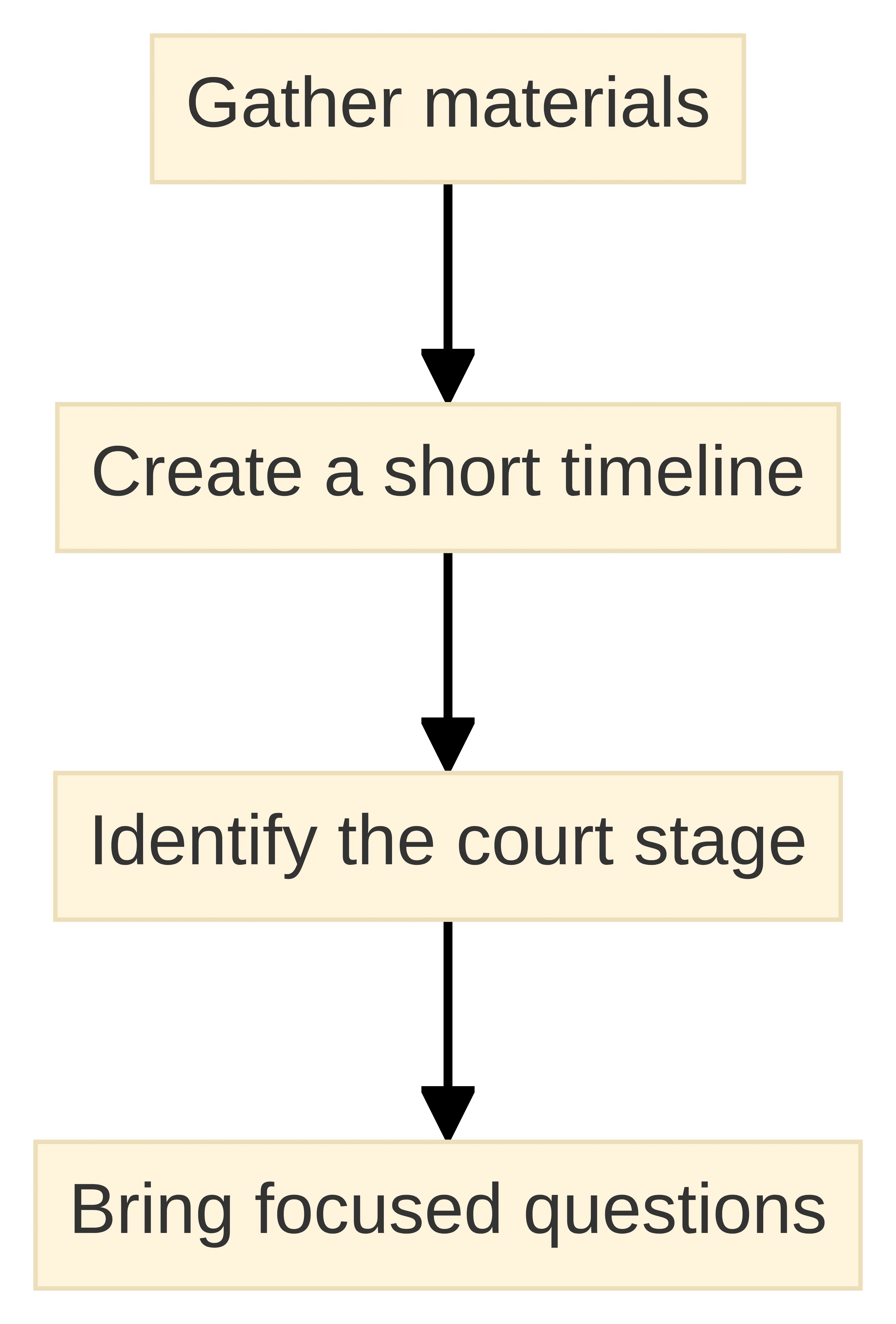
The checklist is a preparation tool, not a substitute for review of the facts and documents. Its immediate use is simple: gather the materials, create a short timeline, identify the court stage if possible, and bring focused questions about whether the practice and proposed representation fit your matter.
Use the consultation to test fit rather than seek a promise
A consultation with the Law Office of Michael R. Reinhardt is described as free and confidential. Use that conversation to explain the matter, identify the documents that control the immediate question, and assess whether the practice’s stated services and working approach fit what you need to discuss.
- What procedural stage does the available paperwork show?
- Which facts or documents need closer review before legal options can be discussed?
- What would the proposed representation include, and what would remain outside its scope?
- Who would communicate with you, and how would you receive updates?
- How would expenses and other practical terms be explained?
- Which decisions would require your direction, and which technical or tactical choices would require legal judgment?
The questions are designed to reveal fit. They are not a way to obtain a prediction before the relevant facts have been reviewed.
After the conversation, assess whether you understand the immediate issue, the proposed working relationship, and the information still needed. Pay attention to whether the discussion addressed your actual question rather than only the general label attached to the matter. If the stated services, communication process, location, and scope do not align with your needs, that is a meaningful fit conclusion.
Our practice states that every case it handles is judged on its own facts and circumstances. That is why a consultation should lead to a clearer review path, not a promise about dismissal, diversion, reduced charges, trial, or another result. Keep the decision tied to the information actually discussed.
Organize Case-Stage Records Before a Massachusetts Criminal Defense Consultation
Start by identifying the Massachusetts paper or court event that marks the matter’s stage—such as a citation, complaint, or arraignment—then consider whether the Law Office of Michael R. Reinhardt’s criminal-defense services in Concord include the kind of matter involved. Gather the basic paperwork, identify the stage you believe the matter has reached, and write down the questions that general information cannot answer.
If the stated fit is relevant, use the consultation to determine whether the proposed working relationship addresses your needs.
What should you ask before contacting a Massachusetts criminal defense lawyer?
What should I consider when evaluating a criminal defense lawyer in Massachusetts?
When evaluating a criminal defense lawyer, consider their experience, communication style, location, and whether their stated services align with your specific legal needs. It’s important to assess how well the lawyer understands your situation and whether you feel comfortable with their approach.
What is the role of a criminal defense lawyer in Massachusetts?
A criminal defense lawyer in Massachusetts may assist with various stages of a criminal matter, including arrest, investigation, charges, arraignment, sentencing, and appeals. They help clients understand the legal process, explore defense options, and represent them in court.
How does the arraignment process work in Massachusetts?
In Massachusetts, an arraignment is the first formal court appearance after a complaint or indictment. During this process, the court identifies the charge, addresses representation, and decides on release conditions, including bail.
What information should I gather before consulting a criminal defense lawyer?
Before consulting a lawyer, gather relevant documents such as complaints, citations, court notices, and any related paperwork. Prepare a timeline of events and a list of questions about your case to facilitate the discussion.
How can I determine if the Law Office of Michael R. Reinhardt is a good fit for my case?
To determine if the Law Office of Michael R. Reinhardt is a good fit, consider their stated services, experience in handling similar cases, communication style, and whether you feel comfortable discussing your situation with them.
Charged with a crime?
Talk to a criminal-defense attorney who knows the Massachusetts courts.
Attorney Michael R. Reinhardt offers free, confidential consultations across Middlesex, Suffolk, and Worcester counties.
More on Criminal Defense: Courts & Process
See every practice area Criminal Defense: Courts & Process
How to Choose a Criminal Defense Lawyer for a Massachusetts Criminal Matter
Learn what a Massachusetts criminal defense lawyer may do, how to prepare, and what to consider before requesting a consultation.
Read article Criminal Defense: Courts & Process
7 Essential Steps to Prepare for Your Hearing Successfully
Prepare effectively for your hearing - np/stet/dismissal/abd with these 7 essential steps for success.
Read article Criminal Defense: Courts & Process
4 Steps to Get Off Probation Early for Good Behavior
Learn how to get off probation early for good behavior with these essential steps and insights.
Read article