
Driving Offenses
What Does Negligent Operation of a Motor Vehicle Mean in Massachusetts?

What the charge means—and what it does not establish
In Massachusetts, negligent operation and reckless operation are criminal motor-vehicle charges, and police may allege either charge after a collision, a reported driving incident, or a traffic stop. The allegation can begin a criminal matter, but it does not by itself resolve whether the required facts can be proved.
The charge does not answer every question about what happened. Three matters require attention: whether you were operating the vehicle, where the alleged operation occurred, and whether the applicable negligence standard is met. Those are questions about the accusation and its supporting facts, not conclusions that can be drawn from the charge label alone.
Your first task is therefore not to predict the result. Start by identifying the exact offense listed on the citation, complaint, or other court paper; the date and location alleged; the procedural stage; and any additional charges. Keep the wording of the paper unchanged in your notes. A small difference in the alleged offense or court posture can change which questions need attention.
Charged? Talk to Attorney Reinhardt.
Leave a name and a number — he reviews every request personally.
The three questions behind the allegation
The allegation rests on three connected questions: operation, location, and the applicable negligence standard. Operation, location, and the applicable negligence or recklessness standard are issues requiring proof. Treat each question as a separate part of the review rather than assuming that one troubling fact answers all three.
Operation asks what evidence connects you to the vehicle and to the driving described in the allegation. Your account of who drove, where the vehicle was, and what happened before and after the incident may matter when compared with the citation, police report, witness accounts, or other records. Do not assume that being near a vehicle or being involved in an incident settles the operation question.
Location asks where the alleged driving took place.
Location is more than the name of a road or town. Whether the place was a public way or a place to which the public had a right of access may be a potential defense issue, including situations involving private property or a driveway. That makes the setting and the public’s access to it relevant factual questions, not details to fill in from memory or assumption. When reviewing the records, describe the place, the route or property involved, and the access facts shown in the materials. A document that gives only an address may not by itself answer every question about the character of the location.
The negligence-standard question asks whether the conduct described in the materials meets the standard applicable to this charge. In plain language, the charge label or the fact of a collision alone does not answer whether the driving meets the applicable negligence standard. Negligent operation and reckless operation are not interchangeable labels because the applicable standards differ. Review the exact allegation alongside the sequence of events, the road or property involved, the observations recorded, and any competing account.. A careful review keeps those factual questions separate from a conclusion about liability.
Negligent, reckless, and OUI allegations are not interchangeable
Negligent operation, reckless operation, and OUI are different allegations, even when they arise from the same traffic event. Massachusetts treats negligent operation and reckless operation as criminal motor-vehicle charges, and negligent operation may appear alongside an OUI charge or a leaving-the-scene charge. The presence of one label does not, by itself, establish the elements of another.
A collision, traffic stop, or reported driving incident may lead police to allege more than one offense. That possibility does not tell you which allegation the prosecution must prove, what evidence relates to each count, or whether one charge changes the consequences associated with another. Read every listed offense separately and write down the exact language rather than reducing the matter to a general description such as a DUI case or an accident case.
Use the charge names as starting points, not as substitutes for the underlying facts. If the papers list multiple offenses, make a separate line for each one and identify the records that appear to support it. Keep questions about alcohol or drug allegations, leaving the scene, driving conduct, and license matters distinct until the documents and applicable law are reviewed together.
Map the conduct and evidence before drawing conclusions
The evidence map should connect each part of the allegation to the material that describes it. The relevant categories are the operation, the location, and the conduct said to meet the applicable standard. For a criminal complaint, the facts forming the basis of the complaint may be recorded or reduced to writing through materials such as a police report, a hearing recording, or written testimony.
A useful way to organize that map is to record the issue, the statement made about it, and the document or account where the statement appears. For operation, note what connects the person to the vehicle and driving. For location, note how the place and public access are described. For the negligence standard, note the conduct observed or reported and any competing account. Then identify what came from the citation, police materials, hearing materials, a witness, or personal recollection. This method does not decide what the charge proves; it shows which facts are documented, which accounts differ, and which questions still require review.
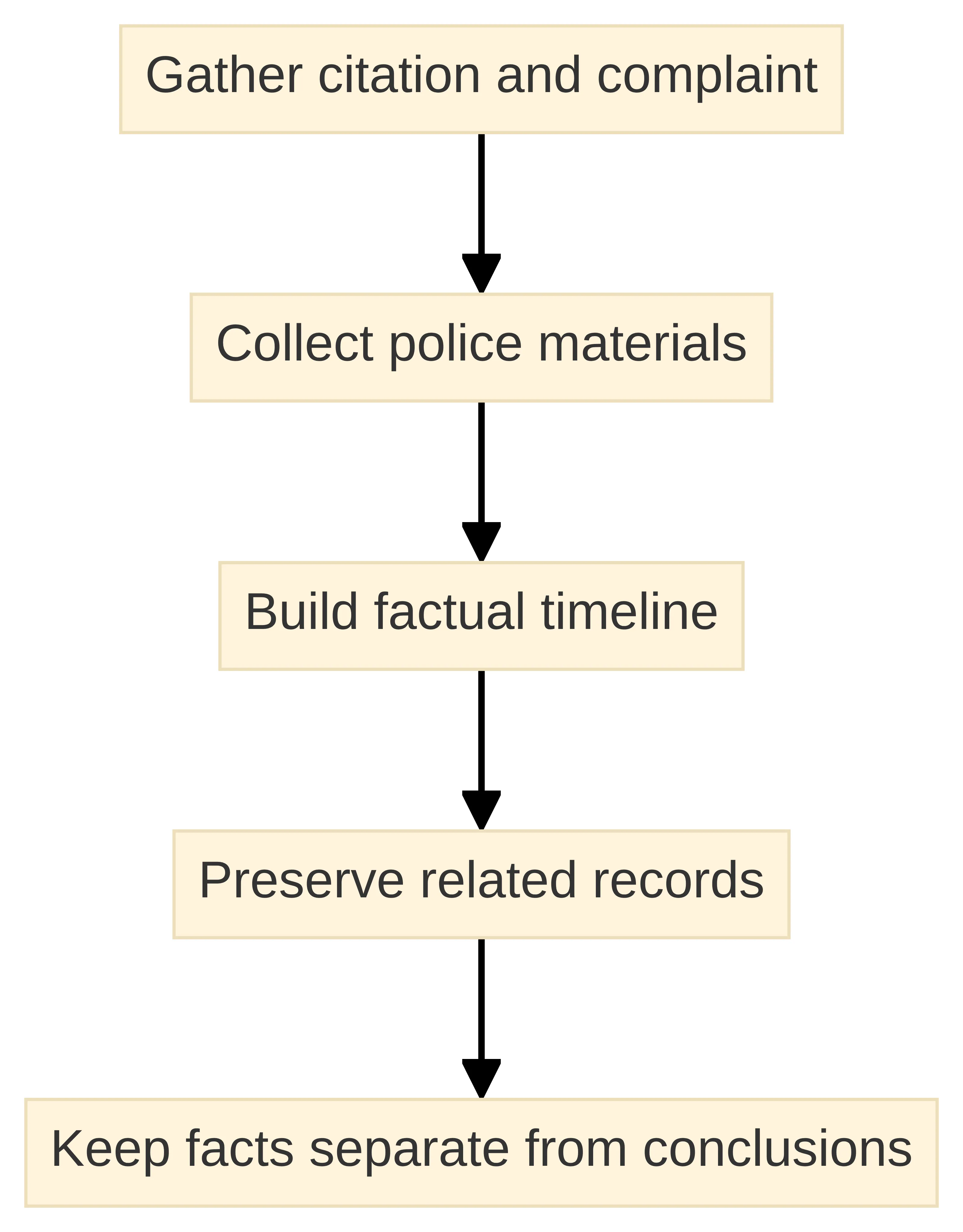
A citation may identify the offense, but a citation alone is not sufficient in the circumstances described; additional material may document the facts forming the complaint. Gather the citation and any complaint, police report, hearing notice, hearing recording information, and written court materials available to you. Preserve each document in its original form and note when and how you received it.
Build a short timeline without arguing the case in the timeline itself. Record the time and place you were driving, the event that led to police involvement, any contact with another driver or witness, the stop or investigation, and what paperwork followed. Mark facts you personally remember separately from facts you learned from a document. That separation helps you identify conflicts instead of accidentally blending the accounts.
Preserve photographs, messages, videos, vehicle information, insurance communications, medical records, and contact details for witnesses if they relate to the incident. Do not edit or delete potentially relevant material. Keep a note of where each item came from and avoid posting a detailed account publicly while the matter is pending. Gathering material is not the same as deciding what it proves; the immediate goal is to keep the factual record organized.
Identify the procedural posture from the papers
The court papers identify the event before the court and any action they may require. When someone is accused of a misdemeanor and was not arrested, Massachusetts generally provides a show-cause hearing before a District Court clerk-magistrate to assess probable cause for issuing the complaint. The hearing concerns whether a complaint should issue; it is not the same question as whether the charge will ultimately be proved.
A person may request a show-cause hearing within four days after receiving a motor-vehicle citation charging only misdemeanor offenses. Because that point depends on the citation and the procedural circumstances, record the date and time you received every paper and act promptly on any stated instruction. Do not assume that a general description of the charge tells you whether this procedure applies.
A show-cause hearing is generally not open to the public, and you may bring witnesses. If your papers refer to such a hearing, keep the notice, citation, and any instructions together. Write down the court, date, time, location, and stated offense exactly as shown. If the papers do not clearly identify the next event, treat that uncertainty as a question to resolve promptly rather than guessing.
A complaint may contain or rely on more than the face of a citation. Complaint facts may be documented through a police report, a hearing recording, or written testimony; a citation alone is not sufficient in the circumstances described. Your file should therefore distinguish the citation from the complaint materials and note which documents you have not yet received.
Separate possible consequences from unsupported predictions
Negligent operation and certain other driving offenses can carry criminal penalties in Massachusetts. Certain Massachusetts driving offenses treated as criminal matters can lead to jail time, fines, and license consequences. Those statements do not establish that every negligent-operation case produces each of those outcomes.
Your possible court consequences depend in part on the procedural stage, including whether the papers involve a citation, a show-cause process, or an issued complaint. License consequences require separate attention when the paperwork refers to a suspension or another Registry matter. Treat any stated suspension period, fine, jail term, or deadline as requiring confirmation against current Massachusetts authority and the papers in your case.
Keep the criminal-case papers and license-related papers in separate parts of your record. For each license reference, note the document that contains it, the date shown, and the action or requirement described, without treating that reference as proof of negligent operation. Likewise, do not treat the possibility of a criminal consequence as an automatic result. Separating these tracks helps identify which question belongs to the court matter, which belongs to the license matter, and which needs current legal review.
A charge is not a reliable basis for predicting the result. The relevant facts may include the alleged location, the conduct described, other charges, the available records, and the stage of the court process. Make a list of every stated consequence, identify the paper that mentions it, and separate a possibility from a confirmed order or requirement. That approach gives you concrete questions without turning general information into a promise.
Issues a lawyer may examine
Potential defense issues depend on the facts and current Massachusetts law. The following areas may warrant examination:
- Another driver’s conduct: whether another driver’s negligence or intoxication contributed to the incident in a way that matters under the applicable law.
- Emergency circumstances: whether an emergency existed and how it relates to the conduct alleged.
- The driving standard: whether the driving was truly negligent or reckless, which may be a defense issue in a driving-offense case.
- Suspension notice: whether you received notice of a suspension, which may also be a defense issue in a driving-offense case.
- The traffic stop: whether the stop was lawful, where a stop forms part of the case.
A location fact may matter differently from an emergency fact, and another driver’s conduct may require a close review of the sequence and available proof. Preserve the facts that relate to each category, then ask which issue is legally relevant to the exact charge and procedural posture shown in your papers.
Build a focused record for review
A focused record lets you explain the matter without relying on memory alone. Put the following items in one folder, with the newest court paper easy to find:
- The citation and complaint: include every page, attachment, and listed offense.
- Court information: record the court, case or docket information shown, scheduled event, date, time, and instructions.
- Police materials: preserve the police report and note whether a hearing recording or written testimony is referenced or available.
- A factual timeline: separate what you personally remember from what appears in the records.
- Location details: identify the roadway, property, access to the area, weather or visibility facts you remember, and any material that shows the setting.
- Related records: include suspension notices, insurance communications, vehicle information, photographs, videos, messages, and witness contact details when they relate to the allegation.
- Questions: write down the consequence, procedural, evidence, and defense questions you need answered.
Use the completed folder to ask focused questions: What exactly must be proved for the listed charge? Which facts support operation, location, and the applicable standard? Does the location, another driver’s conduct, an emergency, suspension notice, or the traffic stop raise an issue? Which court event comes next, and what does each paper require? The questions should follow the documents rather than assume a result.
We offer a free, confidential consultation; requesting one does not itself create an attorney-client relationship. Bring the citation, court information, police materials, timeline, and related records so the discussion can focus on the specific Massachusetts driving matter.
Decide whether to request a case-specific consultation
A Massachusetts negligent-operation charge should be reviewed through its required building blocks, the conduct and location alleged, the records supporting the complaint, and the procedural stage shown on your papers. Possible criminal or license consequences should remain tied to supported facts rather than assumptions. A qualified Massachusetts lawyer must decide how current law applies to your individual circumstances; general information cannot make that decision for you. Gather the records, preserve the timeline, note the deadlines and questions shown in the papers, and use individualized legal guidance to determine what follows.
Charged with a crime?
Charged with a motor-vehicle offense in Massachusetts?
Attorney Michael R. Reinhardt offers free, confidential consultations across Middlesex, Suffolk, and Worcester counties.
More on Driving Offenses
How we handle Driving Offenses Driving Offenses
What Does Negligent Driving Mean in Massachusetts? Start With the Exact Charge
Learn how to read a Massachusetts driving allegation, organize the relevant records, and identify questions for case-specific legal help.
Read article Driving Offenses
Checklist: Can You Drive with a Revoked License? Key Steps to Follow
Discover the legal implications and steps to take if you're wondering, can you drive with a revoked license?
Read article Driving Offenses
Can You Be Arrested for Driving on a Suspended License? Understand the Risks
Understand the risks and legal consequences of driving on a suspended license.
Read article