
Driving Offenses
What Does Negligent Driving Mean in Massachusetts? Start With the Exact Charge

Start with the term—and its limits
The phrase “negligent driving” does not, by itself, identify the exact Massachusetts charge, the conduct alleged, or the records that may matter. Treat it as a starting description rather than a complete answer. The document in front of you—such as a citation or complaint—should guide the next questions.
A charge-first approach means separating four points:
- the exact label and statutory wording;
- the conduct the government alleges;
- the location, traffic control, or event connected to that conduct; and
- the records that may support or challenge the allegation.
That approach keeps you from importing a penalty, defense, or outcome from a different driving matter. It also gives you a more useful set of questions before you decide whether to seek case-specific help.
Massachusetts law provides a concrete example of why conduct and location matter. A driver approaching a yield sign must slow to a speed reasonable for existing conditions and stop if safety requires. The driver must then yield to traffic already in the intersection or close enough to create an immediate hazard. If a driver passes the yield sign without stopping and a collision follows at the intersection or junction, the law treats that collision as prima facie evidence of failure to yield.
That rule addresses a particular traffic-control situation. It does not, by itself, answer whether the allegation in your document is negligent operation, reckless operation, driving to endanger, or another charge. Use the rule as a reminder to identify the specific conduct and place described in your own matter.
Charged? Talk to Attorney Reinhardt.
Leave a name and a number — he reviews every request personally.
Find the exact charge in the citation or complaint
The citation or complaint is the practical starting point for understanding what is alleged against you. Read the document slowly and copy its exact wording before relying on a shortened description such as “negligent driving.” Record the charge label, any statutory reference, the court or issuing authority shown, the date, and the case or docket information if listed.
Keep the original language intact. A change from “negligent operation” to “driving to endanger,” for example, is not a harmless editing choice. These are different charge labels, so keep the exact label when describing the allegation. Your first task is not to decide which label sounds most familiar. Your first task is to identify which label appears on your document.
The document should also be read as an allegation that requires evaluation, not as a prediction of the result. Avoid drawing a conclusion from the title alone. The wording that describes the conduct, the place, and the surrounding circumstances may be more useful for your questions than the short label at the top.
Create a short charge record with these entries:
- Exact charge language.
- Statutory citation or section number, if shown.
- Alleged date, time, and location.
- Description of the conduct, if the document includes one.
- Court, docket, or citation information shown on the paperwork.
- Any reference to a suspension, notice, collision, yield sign, traffic stop, or other event.
This record is an organizing tool. It does not determine whether the allegation can be proved, whether a defense applies, or what result a court may reach. Those questions require a review of the actual circumstances and the law that applies to the precise charge.
Translate the allegation into conduct and location
The alleged conduct and location give meaning to a driving charge. Once you have copied the charge, describe what the document says happened without adding explanations that are not in the record. Note whether the allegation concerns a yield sign, another traffic control, a collision, a stop, a suspension, or a different driving event.
Then identify the place with as much precision as the available documents allow. An intersection, roadway, parking area, or other location may frame the questions you need to ask, but the location alone does not establish a violation. A useful description separates what you know from what the document alleges:
- “The document identifies this intersection.”
- “The document alleges that the vehicle did this.”
- “My records show this separate fact.”
- “I do not yet know whether this point is disputed.”
That separation can prevent assumptions from becoming part of your working account. It also makes it easier to identify which facts need clarification.
A Massachusetts yield-sign allegation illustrates the value of that separation. The applicable rule addresses the speed used while approaching the sign, whether stopping was required for safety, the duty to yield, and the relationship between a collision and an alleged failure to yield. The rule therefore directs attention to the sign, the roadway, the traffic present, the conditions, and what happened at the intersection.
The rule also has a defined evidentiary consequence when a driver passes the sign without stopping and a collision occurs at the intersection or junction. That consequence is tied to the circumstances stated in the law. Do not extend it to every collision or every allegation involving a yield sign. Match the rule to the conduct and location actually described in your paperwork.
Use these questions to translate the allegation into facts:
- What exact act does the document say was negligent, reckless, or dangerous?
- Where did that act allegedly occur?
- What traffic control, roadway feature, or event does the document identify?
- Does the document mention a collision or another consequence?
- Which parts are supported by documents, photographs, recordings, or witnesses you already have?
- Which parts remain unclear or disputed?
The purpose is not to write a final account or select a defense. The purpose is to make the allegation precise enough for a qualified legal review.
Do not collapse negligent operation, reckless operation, and driving to endanger
Negligent operation, reckless operation, and driving to endanger should remain separate labels while you organize the matter.
These labels should not be assumed to have identical elements, to change automatically into one another, or to be satisfied by the same facts. The labels raise different questions:
| Charge label | What this charge involves | Boundary for your review |
|---|---|---|
| Negligent operation | It can carry criminal penalties, and it requires proof of specific conduct and sometimes knowledge. | Do not assume the label alone identifies the conduct or resolves whether the required proof exists. |
| Reckless operation | We identify it as a charge that can carry criminal penalties. | Do not infer its elements or legal theory from the negligent-operation label. |
| Driving to endanger | It can carry criminal penalties, and it requires proof of specific conduct and sometimes knowledge. | Do not assume that a reference to negligent operation answers what must be proved for this charge. |
The practical action is simple: use the label printed on your document and keep the other labels in a separate comparison column. If your paperwork uses “negligent operation,” ask what specific conduct and knowledge the allegation relies on. If it uses “driving to endanger,” ask the same question without treating the two labels as interchangeable. If it uses “reckless operation,” ask for an explanation of the conduct and legal theory involved rather than borrowing the description of another charge.
We identify whether the driving was truly negligent or reckless as a potentially defensible issue in driving-offense cases. That statement does not decide your case. It explains why the exact wording and underlying facts deserve attention.
Ask what notice, stop, and proof the case involves
Notice, the traffic stop, and proof of the alleged conduct can lead to different questions. In driving-offense cases, potentially defensible issues include whether you received notice of a suspension, whether the driving was truly negligent or reckless, and whether the traffic stop was lawful.
Those issues should not be blended together. A notice question concerns what you were told about a suspension and when. A stop question concerns the circumstances that led to the traffic stop. A conduct question concerns what happened while you were driving and what the government must prove for the charge listed. Each question calls for its own documents and factual account.
Do not assume that a suspension reference proves you received notice. Do not assume that a traffic stop was lawful or unlawful from the charge label. Do not assume that describing an event as careless or dangerous establishes the legal proof required. Write down the question first, then identify the record or fact that may answer it.
That description sets a useful boundary: a general account of what happened is not the same as an analysis of whether the required proof exists.
Prepare separate notes for the following:
- what you were told about any suspension;
- what happened before, during, and after the traffic stop, if a stop occurred;
- what the citation or complaint says you did;
- what documents, recordings, or witnesses relate to those points; and
- which facts you cannot presently confirm.
This organization does not predict an outcome. It gives a case-specific reviewer a clearer way to assess the allegation without treating every driving issue as the same question.
Separate the driving record from court and case records
The driving record and the court or case file are different categories for organizing your information. Keep the record requested from the Massachusetts Registry process separate from the citation, complaint, docket materials, correspondence, and other documents connected to the specific allegation. Do not use a driving-record entry as a substitute for reading the charge document, and do not assume that a court document gives you the complete driving-record history.
A simple file structure can help:
- Charge documents: citation, complaint, summons, or other paperwork that states the allegation.
- Case information: court, docket, dates, and filings shown on documents you possess.
- Driving record: Registry-related record and request materials.
- Event information: photographs, recordings, witness details, correspondence, and your factual notes.
- Questions: points that remain unclear after the documents are separated.
This structure is an information aid. It does not tell you which record will control a legal issue or what a court will accept as proof.
Massachusetts gives a license holder requesting their own driving record a defined request process. The request requires a completed Driving Record Request Form, the applicable fee, and a photocopy of the license or identification, except that the photocopy is not required for an in-person request. Use the requirements stated for the request method you choose, and keep the submitted materials with the resulting record.
The record can answer a record-history question, but it does not by itself explain every fact alleged in a citation or complaint. Compare its entries with the exact charge documents rather than treating one document as a replacement for the other.
If you make a Massachusetts public-records request for other material, describe the records sought reasonably and identify a preferred electronic format, if you have one. Public agencies must protect personally identifiable information and redact records when necessary to prevent unwarranted invasions of privacy.
The Massachusetts public-records guidance states that the first four hours of work on a request are provided at no cost; afterward, the agency may charge up to $25 per hour. Treat that as a condition of the request process, not as a prediction that the records will contain the evidence you need. Keep the request, response, redactions, and any fees separate from your court and driving-record materials.
Preserve the information that can clarify the allegation
The information that clarifies a driving allegation is often spread across several documents and memories. Preserve the materials you already have in their original form, and make a working copy for notes. Avoid rewriting the citation, complaint, correspondence, or official record into a shorter version that loses the original wording.
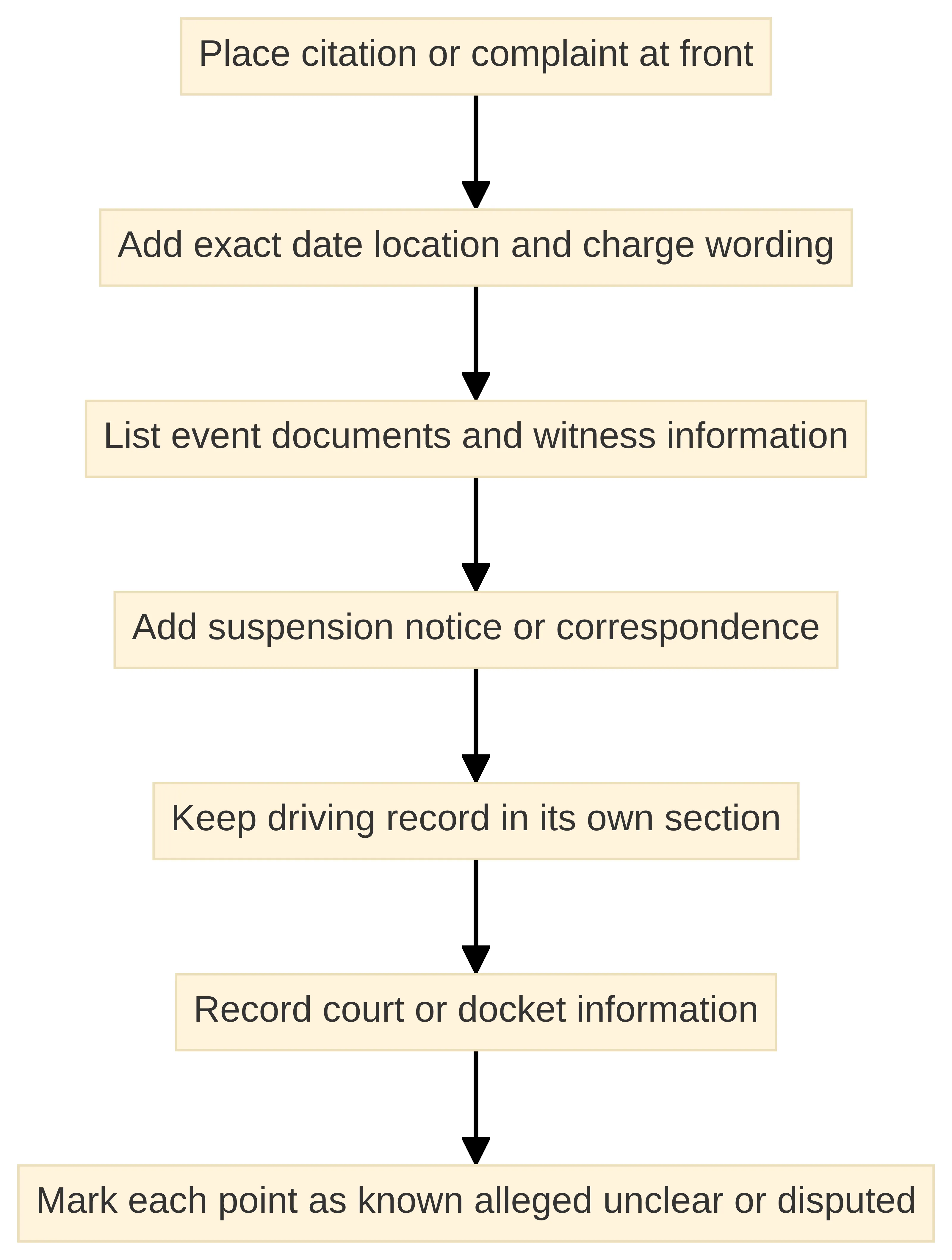
Start with a factual inventory:
- Place the citation or complaint at the front of the file.
- Add the date, location, and charge wording exactly as shown.
- List documents connected to the event, including photographs, recordings, messages, and witness contact information you possess.
- Add any suspension notice or related correspondence without assuming what it proves.
- Keep the driving record in its own section.
- Record the court or docket information shown on the paperwork.
- Mark each point as known, alleged, unclear, or disputed.
The labels in that inventory are for accuracy, not advocacy. “Alleged” means the document attributes the point to the charge. “Known” means you have a basis for recording it as your own fact. “Unclear” identifies a question for further review.
Write questions beside the records that raise them. Examples include:
- What exact conduct is the charge based on?
- Which location or traffic control matters to the allegation?
- What does any suspension notice say, and when was it received?
- What does the driving record show in relation to the date or charge?
- What does the docket or court paperwork establish about the case stage?
- Which facts depend on a witness, recording, or document that is not yet available?
Do not fill an unanswered question with a guess. A clean list of unknowns is more useful than a confident explanation that the documents do not support.
Use a case-specific review before making decisions
A Massachusetts driving allegation becomes easier to discuss when you bring the exact charge, the conduct and location described, the notice and stop information, and the separate record materials together. The goal is not to predict a result from a short label. The goal is to identify the legal and factual questions that require attention.
We handle driving-offense matters. This does not establish that a defense applies to your circumstances.
General legal information cannot determine how the law applies to your facts, and a qualified attorney must assess individual suitability and case-specific options. This information does not create an attorney-client relationship, and contacting our office alone does not create representation. Our consultations are free and confidential.
Questions to resolve about a Massachusetts negligent-driving allegation
How can I request my driving record in Massachusetts?
To request your driving record in Massachusetts, you need to complete a Driving Record Request Form, pay the applicable fee, and provide a photocopy of your license or ID, unless you are making the request in person.
What should I do if I receive a citation for negligent driving?
If you receive a citation for negligent driving, carefully read the document to understand the exact charge and allegations. Document the details, including the charge language, date, and location, and consider seeking legal advice to evaluate your options.
What are the potential defenses against a negligent driving charge?
Potential defenses against a negligent driving charge may include questioning whether the driving was truly negligent, whether you received proper notice of any suspension, and whether the traffic stop was lawful. Each case is unique, so consulting with a legal professional is advisable.
What steps should I take after being charged with negligent driving?
After being charged with negligent driving, gather all relevant documents, including the citation and any evidence related to the incident. Consider consulting with a legal professional to understand your rights and options moving forward.
Charged with a crime?
Charged with a motor-vehicle offense in Massachusetts?
Attorney Michael R. Reinhardt offers free, confidential consultations across Middlesex, Suffolk, and Worcester counties.
More on Driving Offenses
How we handle Driving Offenses Driving Offenses
What Does Negligent Operation of a Motor Vehicle Mean in Massachusetts?
Learn what negligent operation of a motor vehicle means in Massachusetts, what records matter, and which consequences require case-specific review.
Read article Driving Offenses
Checklist: Can You Drive with a Revoked License? Key Steps to Follow
Discover the legal implications and steps to take if you're wondering, can you drive with a revoked license?
Read article Driving Offenses
Can You Be Arrested for Driving on a Suspended License? Understand the Risks
Understand the risks and legal consequences of driving on a suspended license.
Read article